You open your closet on the first day of a new job. There is no dress code memo, just an email that said business casual You own suits. You own T-shirts. Nothing in between feels right.
That gap between a suit and a T-shirt is exactly what business casual attire for men is meant to fill. It is one of the most common dress codes in offices today and also one of the most misunderstood. Get it right and you look sharp without trying too hard. Get it wrong and you either show up overdressed in a full suit or under dressed in jeans and sneakers.
This piece walks through what business casual means, how it stacks up against other dress codes, which pieces to buy first and how to wear them so they work in real life.
What Business Casual Means
Business casual has a simple test. Skip the full suit. Skip the T-shirt and shorts. Everything in between is fair game.
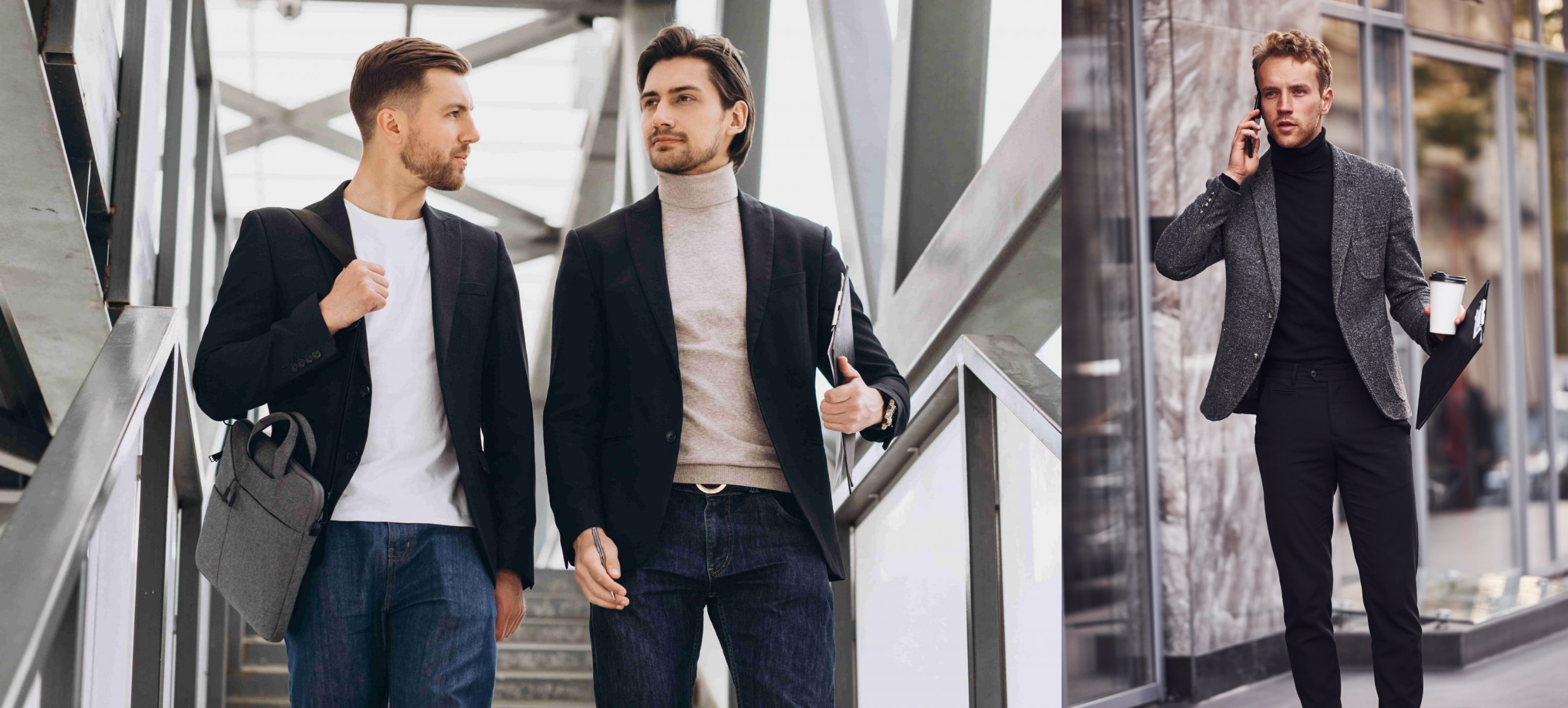
At its core, business casual means a jacket or a smart top, paired with proper trousers and a shirt with a collar. No tie is required. No matching suit is required either. The look should say you made an effort, without saying you tried too hard.
Offices differ in how far they let you swing toward the casual side. A law firm’s version of business casual looks far more formal than a tech startup’s version. That is normal. The core pieces stay the same. Only how far you lean toward casual changes from one office to the next.
How It Compares to Other Dress Codes
Business casual sits between two other dress codes and knowing the difference helps you avoid being too formal or too casual.
Business professional means a full suit: jacket and trousers cut from the same cloth, a tie and dark leather shoes. Law firms, banks and government offices tend to expect this daily. Our men’s formal dress combinations piece has the full breakdown if your office leans this way.
Smart casual sits one step below business casual. Drop the jacket and a collared shirt with chinos is enough. If your office runs looser than business casual, our smart casual outfit piece for men has ideas that fit that lighter dress code.
Here is how the three compare side by side:
| Dress Code | Jacket | Trousers | Tie | Shoes |
| Business Professional | Matching suit jacket | Matching suit trousers | Yes | Formal leather shoes |
| Business Casual | Sport coat or blazer, optional | Tailored trousers or chinos | Optional | Leather shoes or loafers |
| Smart Casual | Rarely worn | Chinos | No | Loafers or clean leather shoes |
The simplest test: if your office expects a matching suit jacket and trousers, you are in business professional territory. If a sport coat over separate trousers does the job, you are in business casual. If there is no jacket at all, you have slipped into smart casual.
Three Easy Ways to Build the Outfit
There is no single business casual outfit. There are three formulas and knowing them removes most of the guesswork.
Jacket and Trousers
Pair a sport coat in navy or dark grey with tailored trousers in a matching or contrasting tone. Add a shirt with a collar in white or blue. Leather shoes finish the look. A tie is optional here, never required.
Job interviews, client meetings and any day you are unsure how formal to go all call for this combination. Our dress pants for men piece walks through the right cut and fit.
Blazer and Chinos
Swap the tailored trousers for a pair of chinos in khaki, olive or grey. Keep the shirt collared. Loafers or a clean pair of leather shoes work well here.
Creative offices, tech companies and most regular days without a client in the room are where this pairing fits best. Our chino pants for men article lays out the fits and colours to shop for.
Shirt and Trousers, No Jacket
Tuck a well-fitted collared shirt into trousers, skip the jacket and you have the lightest version of business casual. Leather shoes still matter here.
Save this one for quiet office days with no meetings that need extra polish. A polo shirt can sometimes replace the collared shirt, especially layered under a jacket. Our piece on wearing a polo shirt with a blazer shows how that combination works.
The Pieces You Need in Your Wardrobe
You do not need to buy everything at once. Nine pieces, chosen well, cover a full working week without repeating an outfit.
| Piece | How Many | What to Look For |
| Sport coat | 1 | Navy, in wool for most of the year |
| Trousers | 2 | Dark grey and navy, flat front |
| Dress shirts | 3 | White, light blue, one subtle pattern |
| Chinos | 1 | Khaki or stone |
| Shoes | 2 | One dark leather pair, one pair of loafers |
| Knit layer | 1 | Merino wool jumper or a high neck sweater |
A navy sport coat works with almost everything else on this list and wool handles most of the year. Save linen or lightweight cotton for the hottest months.
Flat-front trousers look cleaner than pleated ones on most builds. If you are unsure which to buy, our flat front vs pleated trousers piece explains the difference in plain terms.
White and light blue shirts cover most days on their own. Want to go beyond the basics? Our 13 types of shirts for men article breaks down every collar and pattern you might come across.
For shoes, a dark leather pair handles the formal days and a pair of loafers takes care of the rest. Our dress shoes for men roundup has picks for both.
A merino wool jumper or a high neck sweater works well under a jacket once the weather turns cold. Our men’s high neck sweater article has styling ideas for that piece.
Combined, these nine pieces form a small starting wardrobe. If you want a longer version that stretches into weekends too, our men’s capsule wardrobe piece builds on the same idea.
How These Pieces Should Fit

Fit can change an outfit more than the colour or fabric. A cheap jacket that fits well beats an expensive one that does not.
The jacket’s shoulder seam should sit right at the edge of your shoulder, not past it. It should close without pulling across the chest. About half an inch of shirt cuff should show past the jacket sleeve.
The shirt collar should close without a gap and without choking you. The sleeve should end at your wrist bone. Our dress shirt fit for men piece has a full checklist if you want to go deeper on this one garment alone.
Trousers should sit at the waist without a belt doing all the work. A small break at the ankle or none at all, looks cleaner than fabric bunching over your shoe.
None of this needs bespoke tailoring. A local tailor can fix most of these points for a small fee and it is worth every rupee spent.
What to Wear on Different Days
The same small wardrobe stretches across very different situations. Here is how to use it.
For a job interview, go with the jacket-and-trousers formula. Choose a pressed white or blue shirt and leather shoes. Save the looser choices for another day.
On your first day at a new job, dress a little above what you expect everyone else to wear until you learn the office culture. Our what to wear on your first day at work piece has more on reading a new office correctly.
On a regular office day with no meetings, blazer and chinos works well and the no-jacket formula is fine too if that matches what colleagues wear. Watch what people one level above you wear and match it.
Before a client meeting, go back to the jacket-and-trousers formula. If the client works in finance, law or government, add a tie. Dress at least as formally as they will.
Casual Friday is where the lightest version of business casual gets its moment, sometimes even dark jeans if the office allows it. Keep the shirt collared and the shoes clean, even when the rest of the outfit loosens up.
Answers to Real Questions About Business Casual
Are jeans business casual?
Usually not, but some offices make an exception for dark, unripped jeans without fading. If you are unsure, ask a colleague or stick to trousers or chinos instead.
Can I wear sneakers?
Most business casual offices expect leather shoes. A few looser workplaces allow clean, plain leather sneakers, but bright colours and athletic styles are out.
Do I need a tie?
No. A tie stays optional in business casual. Keep one in your desk drawer for the day a client shows up without warning.
Is a polo shirt business casual?
In some offices, yes, especially worn under a blazer. In client-facing settings, a collared dress shirt is the safer pick.
What about shorts?
Skip them. Business casual almost always means full-length trousers, no matter the weather outside.
Is business casual the same as smart casual?
No. Smart casual usually drops the jacket altogether. Business casual expects one, even if you take it off once you sit down at your desk.
Small Things That Can Ruin the Outfit

Getting the big pieces right does not always save an outfit. A handful of small habits quietly undo all that effort.
An un-ironed shirt looks careless even under a sharp jacket. Iron it or choose a wrinkle-resistant fabric if ironing every morning is not something you enjoy.
A mismatched belt and shoes stand out for the wrong reason. Brown shoes call for a brown belt. Black shoes call for a black belt.
Trousers pooling at the ankle undo a good outfit fast. Get them hemmed. A proper break or none at all, always looks cleaner than bunched fabric.
Wearing a suit jacket as a separate is a common misstep. A suit jacket is cut to match its own trousers exactly and worn alone it turns into half a suit, not a sport coat. For a full rundown of jacket types and where each one belongs, our types of jackets for men piece spells out the difference.
Big logos on a shirt or jacket pull attention away from the outfit itself. Save logo-heavy pieces for the weekend.
Dressing With Less Guesswork

Business casual will always have some grey areas, because every office draws the line a little differently. But once you know the three outfit formulas, the fit points that matter and the small habits to avoid, most of the guesswork disappears. Build the nine pieces above and you will have enough combinations to get through any working week looking like you know exactly what you are doing.
The collar maintains a polished frame around the neck replacing the function of the tie.

The Standard: The Button-Down Collar Shirt is the undisputed champion. Choose micro-patterns checks or light stripes over plain white or blue for textural interest. Ensure the collar points are always crisp and ironed.
The Refined Knitwear: In place of a shirt a fine-gauge knitwear piece offers immediate elegance. Options include Merino wool V-necks crew necks or the sophisticated men’s high neck sweater
The Absolute Ban: Polo shirts are generally acceptable but T-shirts and sweatshirts are entirely inappropriate.
III. The Material Scorecard: Achieving Premium Polish
True style is communicated through texture and quality. These are the elements that elevate your Business Casual Attire for Men beyond the basics.

The Fabric Hierarchy
When choosing separates, prioritize materials with natural texture and soft hand-feel. A Merino wool knit polo, for instance, immediately outranks a standard coarse cotton polo due to its subtle sheen and refined drape. Similarly, focus on flannel cotton or tweed for winter blazers and jackets.

Colour Palette Mastery
Utilize a consistent palette of muted neutrals to ensure seamless interchangeability.
Primary Base: Navy Charcoal Grey and Stone Beige.
Accent Colours: Deep Burgundy Forest Green and subdued Brown.
By staying within this restricted palette, you can create dozens of effortless outfits that look intentionally coordinated.
The Footwear Integrity
Footwear is the final judgment on your attention to detail. Your shoes must be polished well-maintained and structured.


Deepak Bhandari has spent 10 years in personal styling, helping men dress with more confidence and less guesswork. He’s the founder of Deepu Fashion, where he writes about style, grooming and everyday outfit ideas that actually work in real life. Follow him on Instagram for daily style tips and inspiration.